HSC Resources · Physics 2
Ch11 Astronomy
Lecture slides and notes for Ch11 Astronomy from the Physics 2 module in HSC Resources by Md Ahbab. 12 pages.
Content Preview
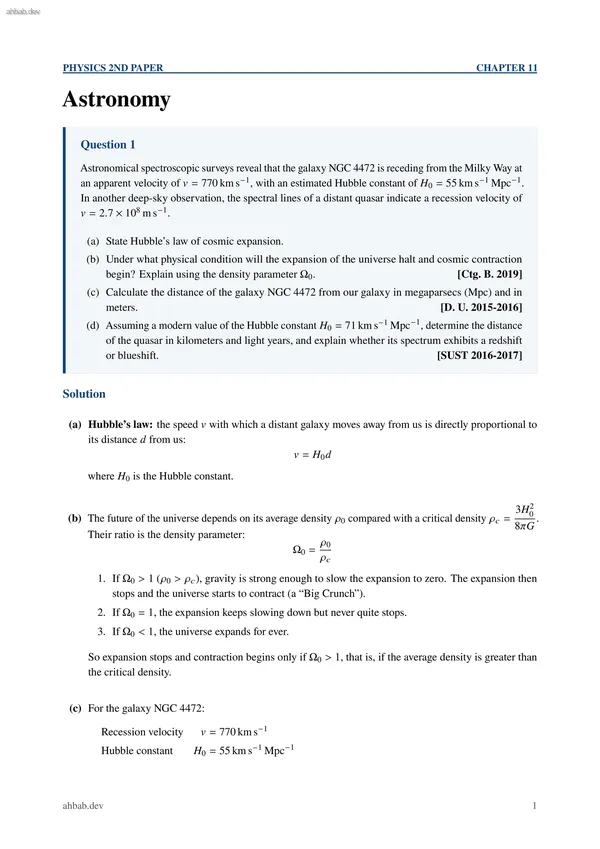
PHYSICS 2ND PAPER CHAPTER 11 Astronomy Question 1 Astronomical spectroscopic surveys reveal that the galaxy NGC 4472 is receding from the Milky Way at an apparent velocity of 𝑣= 770 km s−1, with an estimated Hubble constant of 𝐻0 = 55 km s−1 Mpc−1. In another deep-sky observation, the spectral lines of a distant quasar indicate a recession velocity of 𝑣= 2.7 × 10⁸ m s−1. (a) State Hubble’s law of cosmic expansion. (b) Under what physical condition will the expansion of the universe halt and cosmic contraction begin? Explain using the density parameter Ω0. [Ctg. B. 2019] (c) Calculate the distance of the galaxy NGC 4472 from our galaxy in megaparsecs (Mpc) and in meters. [D. U. 2015-2016] (d) Assuming a modern value of the Hubble constant 𝐻0 = 71 km s−1 Mpc−1, determine the distance of the quasar in kilometers and light years, and explain whether its spectrum exhibits a redshift or blueshift. [SUST 2016-2017] Solution (a) Hubble’s law: the speed 𝑣with which a distant galaxy moves away from us is directly proportional to its distance 𝑑from us: 𝑣= 𝐻0𝑑 where 𝐻0 is the Hubble constant. (b) The future of the universe depends on its average density 𝜌0 compared with a critical density 𝜌𝑐=
By Hubble’s law: 𝑑= 𝑣 𝐻0 = 770 55 = 14 Mpc With 1 Mpc = 3.0857 × 10²² m: 𝑑= 14 × 3.0857 × 1022 = 4.32 × 10²³ m 𝑑= 14 Mpc = 4.32 × 10²³ m (d) For the quasar: Recession velocity 𝑣= 2.7 × 10⁸ m s−1 = 2.7 × 10⁵ km s−1 Hubble constant 𝐻0 = 71 km s−1 Mpc−1 With 1 Mpc = 3.0857 × 10¹⁹ km, the Hubble constant in s−1 is 𝐻0 = 71 3.0857 × 1019 = 2.301 × 10⁻¹⁸ s−1 So the distance is 𝑑= 𝑣 𝐻0 = 2.7 × 10⁵ 2.301 × 10−18 = 1.17 × 10²³ km With 1 ly = 9.461 × 10¹² km: 𝑑= 1.173 × 10²³ 9.461 × 1012 = 1.24 × 10¹⁰ ly Redshift or blueshift: the quasar is moving away from us (𝑣> 0). The light waves it sends are stretched to longer wavelengths. So its spectral lines shift towards the red end of the spectrum. Conclusion: the quasar is about 1.24 × 10¹⁰ light years away, and its spectrum shows a redshift. 𝑑= 1.17 × 10²³ km = 1.24 × 10¹⁰ ly (redshift) ahbab.dev 2
Question 2 The Virgo cluster of galaxies is located at a distance of 𝑑1 = 7.8 × 10⁷ light years from our galaxy. For the Virgo cluster, take the Hubble constant as 𝐻0 = 67 km s−1 Mpc−1. Another distant quasar galaxy is at a distance of 𝑑2 = 2.44 billion light years (2.44 × 10⁹ ly). For the quasar galaxy, take 𝐻0 = 71 km s−1 Mpc−1. (a) What is a light year? (b) What is cosmic microwave background radiation (CMBR), and why is it considered decisive evidence for the Big Bang? [S. B. 2017] (c) Calculate the recession velocity of the Virgo cluster with respect to our galaxy in km s−1. (d) Calculate the recession velocity of the distant quasar galaxy in km s−1 and analyze Edwin Hubble’s linear velocity-distance law. [D. U. 2015-2016] Solution (a) A light year is the distance that light travels in vacuum in one year: 1 ly = 𝑐× 𝑡= 3.0 × 108 × (365.25 × 86400) = 9.46 × 10¹⁵ m (b) Cosmic microwave background radiation (CMBR) is faint microwave radiation that comes equally from all directions of the sky. It has the spectrum of a black body at a temperature of about 2.7 K. Why it supports the Big Bang: 1. The Big Bang theory says the early universe was very hot and dense. About 380000 years af
9 further pages require an access key.
The pages above are free to read. The rest of this document is available to people holding a key issued by the author.