HSC Resources · Physics 2
Ch04 Magnetic Effects of Electric Current and Magnetism
Lecture slides and notes for Ch04 Magnetic Effects of Electric Current and Magnetism from the Physics 2 module in HSC Resources by Md Ahbab. 12 pages.
Content Preview
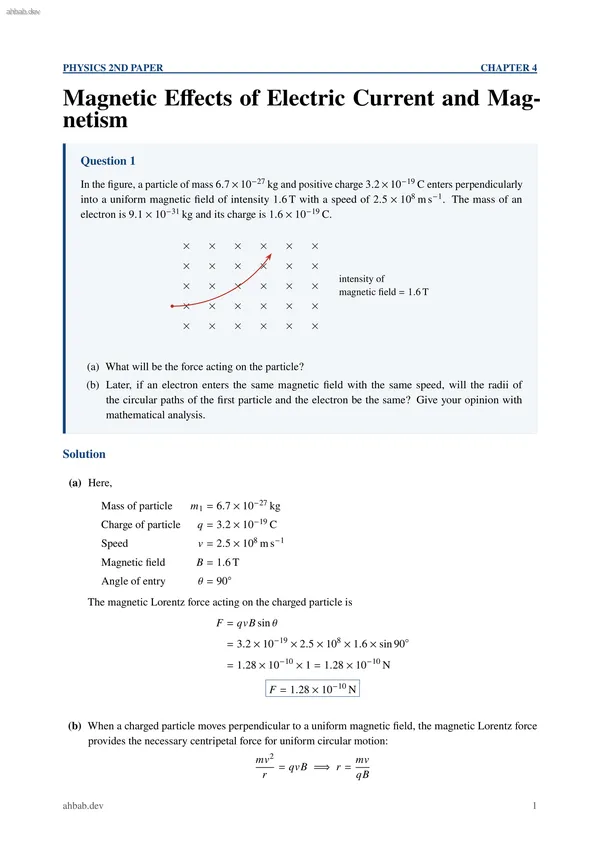
PHYSICS 2ND PAPER CHAPTER 4 Magnetic Effects of Electric Current and Mag- netism Question 1 In the figure, a particle of mass 6.7 × 10⁻²⁷ kg and positive charge 3.2 × 10⁻¹⁹ C enters perpendicularly into a uniform magnetic field of intensity 1.6 T with a speed of 2.5 × 10⁸ m s−1. The mass of an electron is 9.1 × 10⁻³¹ kg and its charge is 1.6 × 10⁻¹⁹ C. intensity of magnetic field = 1.6 T (a) What will be the force acting on the particle? (b) Later, if an electron enters the same magnetic field with the same speed, will the radii of the circular paths of the first particle and the electron be the same? Give your opinion with mathematical analysis. Solution (a) Here, Mass of particle 𝑚1 = 6.7 × 10⁻²⁷ kg Charge of particle 𝑞= 3.2 × 10⁻¹⁹ C Speed 𝑣= 2.5 × 10⁸ m s−1 Magnetic field 𝐵= 1.6 T Angle of entry 𝜃= 90◦ The magnetic Lorentz force acting on the charged particle is 𝐹= 𝑞𝑣𝐵sin 𝜃 = 3.2 × 10−19 × 2.5 × 108 × 1.6 × sin 90◦ = 1.28 × 10−10 × 1 = 1.28 × 10⁻¹⁰ N 𝐹= 1.28 × 10⁻¹⁰ N (b) When a charged particle moves perpendicular to a uniform magnetic field, the magnetic Lorentz force provides the necessary centripetal force for uniform circular motion: 𝑚𝑣2 𝑟 = 𝑞𝑣𝐵=⇒𝑟= 𝑚𝑣 𝑞𝐵 ahbab.dev 1
For the first particle: 𝑟1 = 𝑚1𝑣 𝑞𝐵 = 6.7 × 10−27 × 2.5 × 108 3.2 × 10−19 × 1.6 = 1.675 × 10⁻¹⁸ 5.12 × 10⁻¹⁹ ≈3.27 m For the electron: Mass of electron 𝑚𝑒= 9.1 × 10⁻³¹ kg Charge magnitude 𝑒= 1.6 × 10⁻¹⁹ C Speed 𝑣= 2.5 × 10⁸ m s−1 Magnetic field 𝐵= 1.6 T The radius of the electron’s circular path is 𝑟𝑒= 𝑚𝑒𝑣 𝑒𝐵 = 9.1 × 10−31 × 2.5 × 108 1.6 × 10−19 × 1.6 = 2.275 × 10⁻²² 2.56 × 10⁻¹⁹ ≈8.89 × 10⁻⁴ m = 0.889 mm Comparing the two radii: 𝑟1 𝑟𝑒 = 3.27 8.89 × 10⁻⁴ ≈3678 Since 𝑟= 𝑚𝑣 𝑞𝐵and 𝑣, 𝐵are the same, 𝑟∝𝑚 𝑞. The ratio 𝑚/𝑞of the particle is about 3680 times that of the electron. Conclusion: the radius for the particle is 3.27 m and for the electron only 8.89 × 10⁻⁴ m. So the radii will not be the same. 𝑟1 = 3.27 m, 𝑟𝑒= 8.89 × 10⁻⁴ m =⇒𝑟1 ≠𝑟𝑒 ahbab.dev 2
Question 2 The magnetic field at point 𝑃is 2.0 × 10⁻⁵ T, situated at a perpendicular distance 𝑎from a straight wire 𝐴𝐵= 6 m carrying an electric current of 2 A. Affan converted the wire into a circular coil of 3 turns, passed the same current through the coil, and stated: “The magnetic field at the centre of the coil will be more than 2.0 × 10⁻⁵ T.” The magnetic permeability is 4𝜋× 10−7 T m A−1. 𝐴 𝐵 𝐼= 2 A 𝑎 𝑃 (a) Determine the value of perpendicular distance 𝑎. (b) Comment with appropriate analysis whether the observation of Affan was correct or not. Solution (a) Here, Magnetic field at 𝑃 𝐵= 2.0 × 10⁻⁵ T Current 𝐼= 2 A Permeability constant 𝜇0 2𝜋= 2 × 10⁻⁷ T m A−1 The magnetic field at perpendicular distance 𝑎from a straight wire is 𝐵= 𝜇0𝐼 2𝜋𝑎=⇒𝑎= 𝜇0𝐼 2𝜋𝐵 𝑎= 2 × 10−7 × 2 2.0 × 10−5 = 4.0 × 10⁻⁷ 2.0 × 10−5 = 0.02 m = 2 cm 𝑎= 0.02 m = 2 cm (b) The total length of the wire is 𝐿= 6 m. When converted into a circular coil of 𝑁= 3 turns, the circumference of each turn is 2𝜋𝑟= 𝐿 𝑁= 6 3 = 2 m =⇒𝑟= 1 𝜋m ≈0.3183 m The magnetic field at the centre of a circular coil of 𝑁turns carrying current 𝐼is 𝐵′ = 𝜇0𝑁𝐼 2𝑟 = 4𝜋× 10−7 × 3 × 2 2 × (1/𝜋) ahbab.dev 3
9 further pages require an access key.
The pages above are free to read. The rest of this document is available to people holding a key issued by the author.