HSC Resources · Physics 2
Ch08 Introduction to Modern Physics
Lecture slides and notes for Ch08 Introduction to Modern Physics from the Physics 2 module in HSC Resources by Md Ahbab. 13 pages.
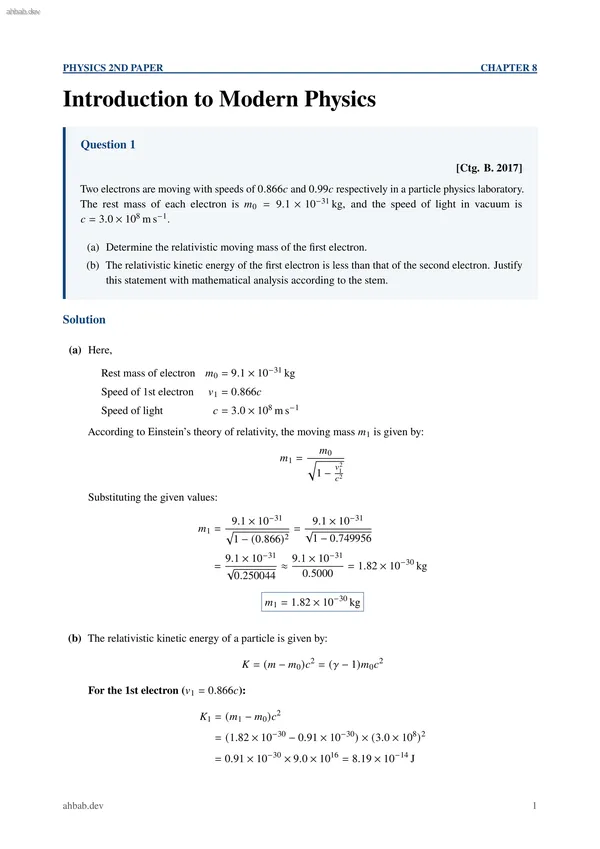
Content Preview
PHYSICS 2ND PAPER CHAPTER 8 Introduction to Modern Physics Question 1 [Ctg. B. 2017] Two electrons are moving with speeds of 0.866𝑐and 0.99𝑐respectively in a particle physics laboratory. The rest mass of each electron is 𝑚0 = 9.1 × 10⁻³¹ kg, and the speed of light in vacuum is 𝑐= 3.0 × 10⁸ m s−1. (a) Determine the relativistic moving mass of the first electron. (b) The relativistic kinetic energy of the first electron is less than that of the second electron. Justify this statement with mathematical analysis according to the stem. Solution (a) Here, Rest mass of electron 𝑚0 = 9.1 × 10⁻³¹ kg Speed of 1st electron 𝑣1 = 0.866𝑐 Speed of light 𝑐= 3.0 × 10⁸ m s−1 According to Einstein’s theory of relativity, the moving mass 𝑚1 is given by: 𝑚1 = 𝑚0 √︃ 1 − 𝑣2 1 𝑐2 Substituting the given values: 𝑚1 = 9.1 × 10⁻³¹ √︁ 1 −(0.866)2 = 9.1 × 10⁻³¹ √ 1 −0.749956 = 9.1 × 10⁻³¹ √ 0.250044 ≈9.1 × 10⁻³¹ 0.5000 = 1.82 × 10⁻³⁰ kg 𝑚1 = 1.82 × 10⁻³⁰ kg (b) The relativistic kinetic energy of a particle is given by: 𝐾= (𝑚−𝑚0)𝑐2 = (𝛾−1)𝑚0𝑐2 For the 1st electron (𝑣1 = 0.866𝑐): 𝐾1 = (𝑚1 −𝑚0)𝑐2 = (1.82 × 10⁻³⁰ −0.91 × 10−30) × (3.0 × 108)2 = 0.91 × 10−30 × 9.0 × 1016 = 8.19 × 10⁻¹⁴ J ahbab.dev 1
For the 2nd electron (𝑣2 = 0.99𝑐): √︄ 1 − 𝑣2 2 𝑐2 = √︁ 1 −(0.99)2 = √ 1 −0.9801 = √ 0.0199 ≈0.14107 𝑚2 = 𝑚0 √︃ 1 − 𝑣2 2 𝑐2 = 9.1 × 10⁻³¹ 0.14107 ≈6.451 × 10⁻³⁰ kg The relativistic kinetic energy of the 2nd electron is: 𝐾2 = (𝑚2 −𝑚0)𝑐2 = (6.451 × 10⁻³⁰ −0.910 × 10−30) × (3.0 × 108)2 = 5.541 × 10−30 × 9.0 × 1016 = 4.987 × 10⁻¹³ J ≈4.99 × 10⁻¹³ J Comparison: 𝐾1 = 8.19 × 10⁻¹⁴ J < 𝐾2 = 4.99 × 10⁻¹³ J The relativistic kinetic energy of the second electron is approximately 6.1 times greater than that of the first electron. Therefore, the statement in the stem is mathematically justified. 𝐾1 = 8.19 × 10⁻¹⁴ J < 𝐾2 = 4.99 × 10⁻¹³ J (Statement is verified) ahbab.dev 2
Question 2 [D. B. 2017] Suppose NASA scientists, detecting a planet situated 370 light-years from Earth that is suitable for living animals, sent a 50-year-old tortoise to that planet in a spaceship moving with velocity 𝑣= 0.7𝑐. The rest mass of the tortoise is 30 kg and its average lifespan is 450 years. (1 light-year = 9.46×10¹⁵ m, 𝑐= 3.0 × 10⁸ m s−1). (a) Determine the total relativistic energy of the tortoise while moving. (b) Verify with mathematical analysis whether the tortoise will be able to reach that exoplanet alive. Solution (a) Here, Rest mass of tortoise 𝑚0 = 30 kg Velocity of spaceship 𝑣= 0.7𝑐 Speed of light 𝑐= 3.0 × 10⁸ m s−1 The relativistic factor is: √︂ 1 −𝑣2 𝑐2 = √︁ 1 −(0.7)2 = √ 1 −0.49 = √ 0.51 ≈0.71414 The relativistic moving mass 𝑚is: 𝑚= 𝑚0 √︃ 1 −𝑣2 𝑐2 = 30 0.71414 ≈42.008 kg The total relativistic energy of the tortoise is: 𝐸= 𝑚𝑐2 = 42.008 × (3.0 × 108)2 = 42.008 × 9.0 × 1016 = 3.7807 × 10¹⁸ J ≈3.78 × 10¹⁸ J 𝐸= 3.78 × 10¹⁸ J (b) Distance to the exoplanet: 𝑑= 370 light-years. In Earth’s reference frame, the time required to complete the journey is: 𝑡= 𝑑 𝑣= 370 ly 0.7𝑐= 370 0.7 ≈528.57 years According to the special theory of relativity, biological aging depe
10 further pages require an access key.
The pages above are free to read. The rest of this document is available to people holding a key issued by the author.