HSC Resources · Physics 2
Ch07 Physical Optics
Lecture slides and notes for Ch07 Physical Optics from the Physics 2 module in HSC Resources by Md Ahbab. 14 pages.
Content Preview
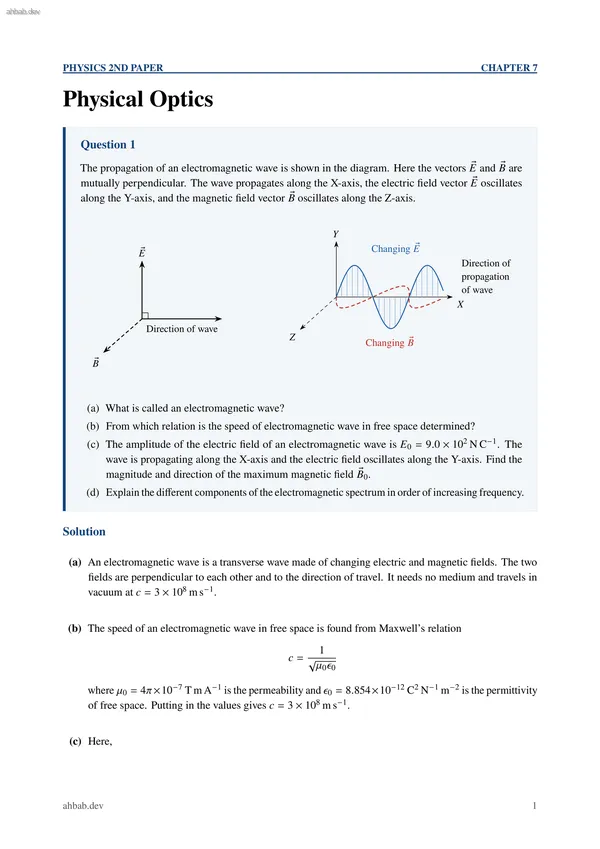
PHYSICS 2ND PAPER CHAPTER 7 Physical Optics Question 1 The propagation of an electromagnetic wave is shown in the diagram. Here the vectors ®𝐸and ®𝐵are mutually perpendicular. The wave propagates along the X-axis, the electric field vector ®𝐸oscillates along the Y-axis, and the magnetic field vector ®𝐵oscillates along the Z-axis. ®𝐸 Direction of wave ®𝐵 𝑌 𝑋 𝑍 Changing ®𝐸 Changing ®𝐵 Direction of propagation of wave (a) What is called an electromagnetic wave? (b) From which relation is the speed of electromagnetic wave in free space determined? (c) The amplitude of the electric field of an electromagnetic wave is 𝐸0 = 9.0 × 10² N C−1. The wave is propagating along the X-axis and the electric field oscillates along the Y-axis. Find the magnitude and direction of the maximum magnetic field ®𝐵0. (d) Explain the different components of the electromagnetic spectrum in order of increasing frequency. Solution (a) An electromagnetic wave is a transverse wave made of changing electric and magnetic fields. The two fields are perpendicular to each other and to the direction of travel. It needs no medium and travels in vacuum at 𝑐= 3 × 10⁸ m s−1. (b) The speed of an electromagnetic wave in free
Amplitude of electric field 𝐸0 = 9.0 × 10² N C−1 Direction of travel +𝑋axis (ˆ𝚤) Direction of ®𝐸 𝑌axis ( ˆ𝚥) Speed of light 𝑐= 3.0 × 10⁸ m s−1 Magnitude: 𝐵0 = 𝐸0 𝑐 = 9.0 × 10² 3.0 × 108 = 3.0 × 10⁻⁶ T Direction: the wave travels along ®𝐸× ®𝐵. So the unit vector of ®𝐵must satisfy ˆ𝚥× ˆ𝑢𝐵= ˆ𝚤 Since ˆ𝚥× ˆ𝑘= ˆ𝚤, we get ˆ𝑢𝐵= ˆ𝑘. So ®𝐵0 is along the Z axis. 𝐵0 = 3.0 × 10⁻⁶ T, along the Z axis (d) The electromagnetic spectrum in order of increasing frequency (and decreasing wavelength) is: Region Frequency (Hz) Uses 1. Radio waves below 109 radio, television, mobile communication 2. Microwaves 109 to 1012 radar, satellite links, microwave ovens 3. Infrared 1012 to 4 × 10¹⁴ heating, night vision, remote controls 4. Visible light 4 × 10¹⁴ to 7.5 × 10¹⁴ seeing, photography 5. Ultraviolet 7.5 × 10¹⁴ to 3 × 10¹⁶ killing germs, making vitamin D 6. X-rays 3 × 10¹⁶ to 3 × 10¹⁹ medical images of bones 7. Gamma rays above 3 × 10¹⁹ cancer treatment, nuclear studies All these waves travel at the same speed 𝑐in vacuum. As the frequency rises, the photon energy 𝐸= ℎ𝜈 rises. So ultraviolet, X-rays and gamma rays can ionize atoms and pass through matter more easily. ahbab.dev 2
Question 2 Look at the diagram, in which a plane wave front is incident obliquely on a plane reflecting surface 𝑋𝑌, and answer the following questions. The refractive indices of water and glass are 1.33 and 1.5 respectively. 𝑋 𝑌 𝐶 𝐷 𝑁 𝐴 𝐸 𝐹 𝐵 (a) What is called a wave front? (b) State and explain Huygens’s principle of secondary wavelets with an illustrative diagram. (c) If the speed of light in water is 2.28 × 10⁸ m s−1, find the speed of light in crown glass. (d) The diagram is drawn on the basis of Huygens’s principle of propagation of light. Describe the diagram and show that it obeys the laws of reflection of light. Solution (a) A wave front is the surface through all the points of a medium that vibrate in the same phase at a given instant. (b) Huygens’s principle: 1. Every point on a wave front acts as a new source of secondary wavelets. These wavelets spread out in the forward direction with the speed of the wave in that medium. 2. After a time 𝑡, the surface that touches all the secondary wavelets in the forward direction (their forward envelope) is the new wave front. In the figure, 𝐴𝐵is a plane wave front at 𝑡= 0. Each point on it sends a wavelet of radius 𝑟= 𝑣𝑡. The comm
11 further pages require an access key.
The pages above are free to read. The rest of this document is available to people holding a key issued by the author.