HSC Resources · Physics 2
Ch03 Current Electricity
Lecture slides and notes for Ch03 Current Electricity from the Physics 2 module in HSC Resources by Md Ahbab. 14 pages.
Content Preview
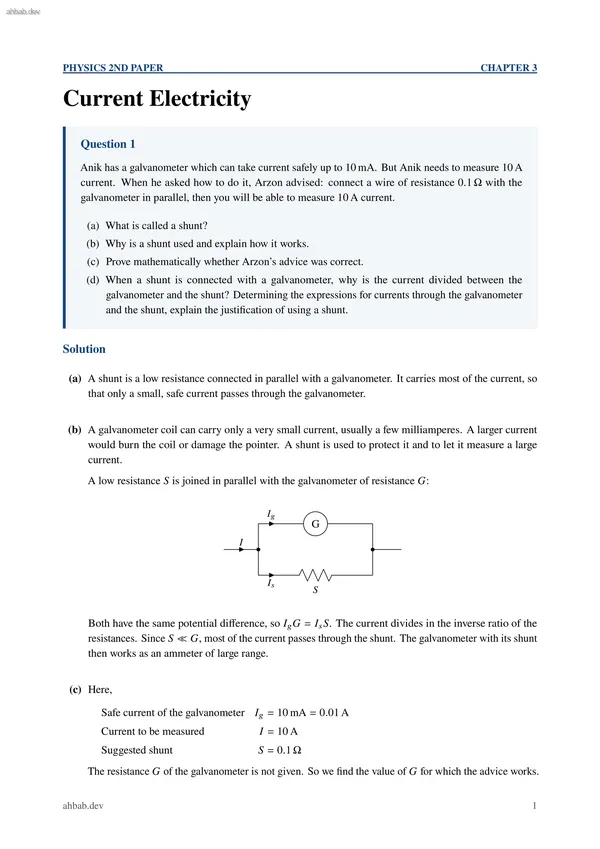
PHYSICS 2ND PAPER CHAPTER 3 Current Electricity Question 1 Anik has a galvanometer which can take current safely up to 10 mA. But Anik needs to measure 10 A current. When he asked how to do it, Arzon advised: connect a wire of resistance 0.1 Ω with the galvanometer in parallel, then you will be able to measure 10 A current. (a) What is called a shunt? (b) Why is a shunt used and explain how it works. (c) Prove mathematically whether Arzon’s advice was correct. (d) When a shunt is connected with a galvanometer, why is the current divided between the galvanometer and the shunt? Determining the expressions for currents through the galvanometer and the shunt, explain the justification of using a shunt. Solution (a) A shunt is a low resistance connected in parallel with a galvanometer. It carries most of the current, so that only a small, safe current passes through the galvanometer. (b) A galvanometer coil can carry only a very small current, usually a few milliamperes. A larger current would burn the coil or damage the pointer. A shunt is used to protect it and to let it measure a large current. A low resistance 𝑆is joined in parallel with the galvanometer of resistance 𝐺: 𝐼 𝐼𝑔 G 𝐼𝑠 𝑆
When 𝐼= 10 A flows in the main line, the galvanometer must carry only 𝐼𝑔= 0.01 A. The shunt then carries 𝐼−𝐼𝑔. The potential difference across both is the same: 𝐼𝑔𝐺= (𝐼−𝐼𝑔)𝑆 𝐺= 𝐼−𝐼𝑔 𝐼𝑔 𝑆 = 10 −0.01 0.01 × 0.1 = 999 × 0.1 = 99.9 Ω If 𝐺= 99.9 Ω, a current of exactly 10 A gives the full-scale current of 10 mA in the galvanometer. If 𝐺 is larger, the galvanometer current is less than 10 mA, so it is still safe. If 𝐺is smaller than 99.9 Ω, more than 10 mA passes through the coil and it may be damaged. Conclusion: Arzon’s advice is correct if the galvanometer resistance is 99.9 Ω (or more). 𝐺= 99.9 Ω for a full-scale reading of 10 A (d) The galvanometer and the shunt are joined in parallel (see the figure in (b)). The main current reaches a junction where it has two paths. By Kirchhoff’s current law, it divides between them: 𝐼= 𝐼𝑔+ 𝐼𝑠 (1) Both branches are connected between the same two points. So they have the same potential difference: 𝐼𝑔𝐺= 𝐼𝑠𝑆=⇒𝐼𝑠= 𝐼𝑔 𝐺 𝑆 (2) Current through the galvanometer. Putting (2) in (1): 𝐼= 𝐼𝑔+ 𝐼𝑔 𝐺 𝑆= 𝐼𝑔 𝐺+ 𝑆 𝑆 𝐼𝑔= 𝑆 𝐺+ 𝑆𝐼 Current through the shunt. From (1): 𝐼𝑠= 𝐼−𝐼𝑔= 𝐼− 𝑆 𝐺+ 𝑆𝐼 = 𝐺 𝐺+ 𝑆𝐼 Justification of using a shunt. The shunt resistance is very small, 𝑆≪
Question 2 In a kettle of power 2 kW, 2 L of water starts boiling in 4 min during summer. In winter the same quantity of water takes one more minute to boil. Observing the situation the teacher said, “This happens due to the difference of temperature”. (Specific heat of water is 4200 J kg−1 K−1) [M. B. 2019] (a) Find the quantity of heat produced in the kettle in winter. (b) Justify the teacher’s statement by determining the initial water temperature in summer and winter according to the stem. Solution (a) Here, Power of the kettle 𝑃= 2 kW = 2000 W Time to boil in winter 𝑡𝑤= (4 + 1) min = 5 min = 300 s The heat produced by the kettle in winter is 𝑄𝑤= 𝑃𝑡𝑤 = 2000 × 300 = 6.0 × 10⁵ J 𝑄𝑤= 6.0 × 10⁵ J (b) Here, mass of 2 L of water 𝑚= 2 kg, 𝑠= 4200 J kg−1 K−1, boiling point 100 ◦C, and time in summer 𝑡𝑠= 4 min = 240 s. Heat produced in summer: 𝑄𝑠= 𝑃𝑡𝑠= 2000 × 240 = 4.8 × 10⁵ J We take that all the heat produced is taken by the water. If the initial temperature is 𝜃, then 𝑄= 𝑚𝑠(100 −𝜃) Summer: 2 × 4200 × (100 −𝜃𝑠) = 4.8 × 10⁵ 100 −𝜃𝑠= 4.8 × 10⁵ 8400 = 57.14 𝜃𝑠= 42.86 ◦C Winter: 2 × 4200 × (100 −𝜃𝑤) = 6.0 × 10⁵ 100 −𝜃𝑤= 6.0 × 10⁵ 8400 = 71.43 𝜃𝑤= 28.57 ◦C ahbab.dev 3
11 further pages require an access key.
The pages above are free to read. The rest of this document is available to people holding a key issued by the author.