HSC Resources · Chemistry 2
Ch05 Economic Chemistry
Lecture slides and notes for Ch05 Economic Chemistry from the Chemistry 2 module in HSC Resources by Md Ahbab. 22 pages.
Content Preview
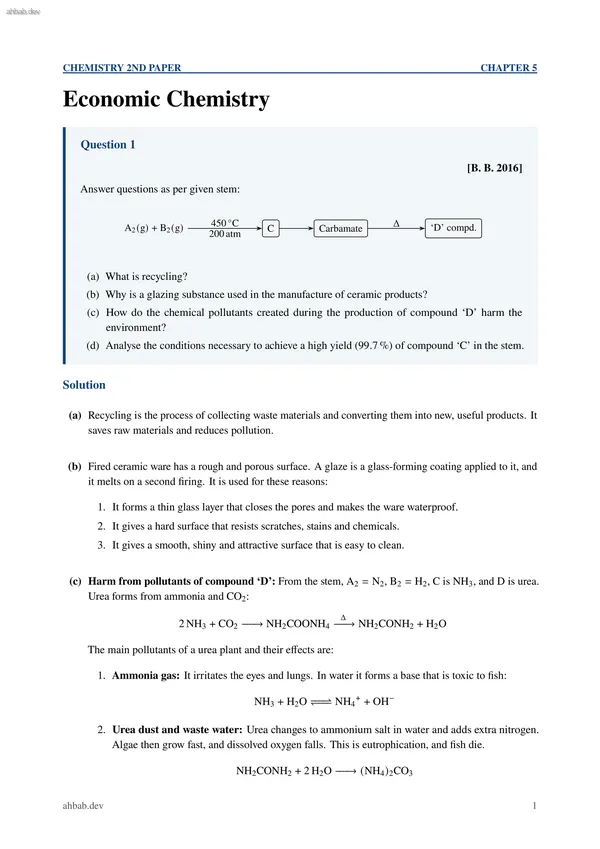
CHEMISTRY 2ND PAPER CHAPTER 5 Economic Chemistry Question 1 [B. B. 2016] Answer questions as per given stem: A2(g) + B2(g) C Carbamate ‘D’ compd. 450 ◦C 200 atm Δ (a) What is recycling? (b) Why is a glazing substance used in the manufacture of ceramic products? (c) How do the chemical pollutants created during the production of compound ‘D’ harm the environment? (d) Analyse the conditions necessary to achieve a high yield (99.7 %) of compound ‘C’ in the stem. Solution (a) Recycling is the process of collecting waste materials and converting them into new, useful products. It saves raw materials and reduces pollution. (b) Fired ceramic ware has a rough and porous surface. A glaze is a glass-forming coating applied to it, and it melts on a second firing. It is used for these reasons: 1. It forms a thin glass layer that closes the pores and makes the ware waterproof. 2. It gives a hard surface that resists scratches, stains and chemicals. 3. It gives a smooth, shiny and attractive surface that is easy to clean. (c) Harm from pollutants of compound ‘D’: From the stem, A2 = N2, B2 = H2, C is NH3, and D is urea. Urea forms from ammonia and CO2: 2 NH3 + CO2 −−−→NH2COONH4 Δ −−−→NH2CONH2 +
3. Carbon dioxide: It comes from the natural gas stage. It is a greenhouse gas and adds to global warming. 4. Nitrogen oxides: They come from furnace gases and cause acid rain: 3 NO2 + H2O −−−→2 HNO3 + NO (d) Conditions for a high yield of compound ‘C’ (ammonia): Ammonia forms by a reversible, exothermic reaction: N2(g) + 3 H2(g) Fe −−−−−−−−−−−−⇀ ↽−−−−−−−−−−−− 450 ◦C, 200 atm 2 NH3(g), Δ𝐻= −92 kJ mol−1 Le Chatelier’s principle shows the effect of each condition: 1. High pressure: Four moles of gas change to two moles. So high pressure moves the equilibrium forward. The stem uses 200 atm. 2. Low temperature: The forward reaction is exothermic, so a low temperature favours ammonia. But the rate is too slow when it is very low. So 450 ◦C is used as a balance. 3. Catalyst: Iron with promoters makes the reaction reach equilibrium faster. It does not change the position of equilibrium. 4. Pure gases in the 1:3 ratio: Pure N2 and H2 are used in the mole ratio of the equation. This protects the catalyst from poisoning. 5. Removal of ammonia and recycling: One pass at 450 ◦C and 200 atm converts only about 15 to 25 %. So ammonia is liquefied and removed, and this moves the equilibrium forwa
Question 2 [All Boards 2018] Answer the related questions as per given stem: CH3 –COONa ‘X’ H2 ‘Y’ ‘Z’ compd. NaOH(CaO) Δ N2 (i) CO2 (ii) Δ (a) What is annealing? (b) Why is gypsum used in cement manufacturing? (c) Write the chemical principle and reactions involved in the industrial production of compound ‘Z’. (d) Analyse whether the excessive and indiscriminate use of compound ‘Z’ in agricultural soils causes environmental hazards. Solution (a) Annealing is the slow and controlled cooling of a hot material, such as glass or metal. It removes internal stress and makes the material less brittle. (b) Cement clinker contains tricalcium aluminate (3 CaO · Al2O3). It reacts with water very quickly, so cement without gypsum sets almost at once. This is called flash setting. About 2 to 3 % gypsum is ground with the clinker. It reacts with the aluminate and forms an insoluble coating: 3 CaO · Al2O3 + 3 CaSO4 · 2 H2O + 26 H2O −−−→3 CaO · Al2O3 · 3 CaSO4 · 32 H2O This coating slows the reaction, so workers get enough time to mix and place the cement. (c) Principle of production of compound ‘Z’ (urea): From the stem, X is methane (CH4), Y is ammonia (NH3) and Z is urea. Urea forms when ammon
19 further pages require an access key.
The pages above are free to read. The rest of this document is available to people holding a key issued by the author.