HSC Resources · Chemistry 2
Ch01 Environmental Chemistry
Lecture slides and notes for Ch01 Environmental Chemistry from the Chemistry 2 module in HSC Resources by Md Ahbab. 24 pages.
Content Preview
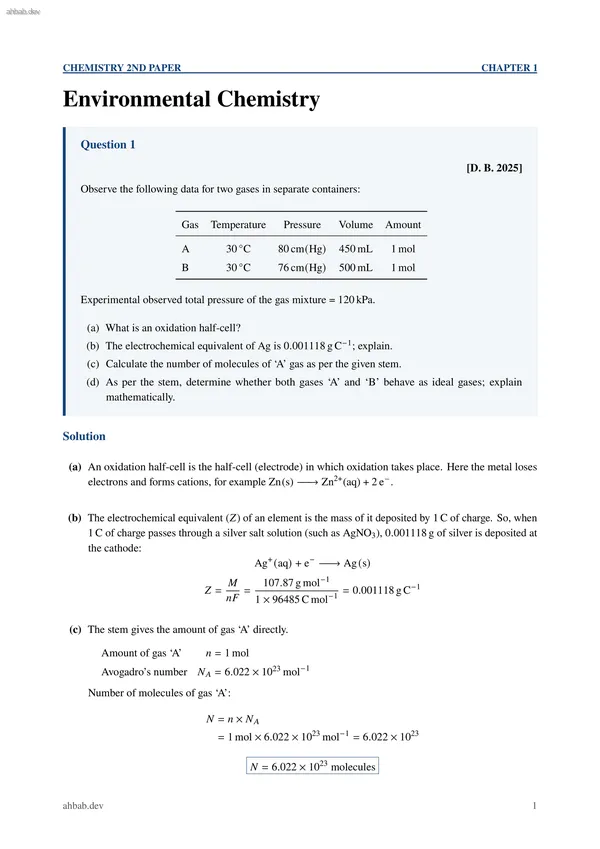
CHEMISTRY 2ND PAPER CHAPTER 1 Environmental Chemistry Question 1 [D. B. 2025] Observe the following data for two gases in separate containers: Gas Temperature Pressure Volume Amount A 30 ◦C 80 cm(Hg) 450 mL 1 mol B 30 ◦C 76 cm(Hg) 500 mL 1 mol Experimental observed total pressure of the gas mixture = 120 kPa. (a) What is an oxidation half-cell? (b) The electrochemical equivalent of Ag is 0.001118 g C−1; explain. (c) Calculate the number of molecules of ‘A’ gas as per the given stem. (d) As per the stem, determine whether both gases ‘A’ and ‘B’ behave as ideal gases; explain mathematically. Solution (a) An oxidation half-cell is the half-cell (electrode) in which oxidation takes place. Here the metal loses electrons and forms cations, for example Zn(s) −−−→Zn2+(aq) + 2 e–. (b) The electrochemical equivalent (𝑍) of an element is the mass of it deposited by 1 C of charge. So, when 1 C of charge passes through a silver salt solution (such as AgNO3), 0.001118 g of silver is deposited at the cathode: Ag+(aq) + e−−−−→Ag(s) 𝑍= 𝑀 𝑛𝐹= 107.87 g mol−1 1 × 96485 C mol−1 = 0.001118 g C−1 (c) The stem gives the amount of gas ‘A’ directly. Amount of gas ‘A’ 𝑛= 1 mol Avogadro’s number 𝑁𝐴= 6.022 × 1
Note: If 𝑛is found from the measured 𝑃, 𝑉and 𝑇with 𝑃𝑉= 𝑛𝑅𝑇, then 𝑛= (80/76)×0.450 0.0821×303 = 0.0190 mol and 𝑁= 1.15 × 10²². The two values do not agree. Part (d) uses this difference. (d) For an ideal gas, 𝑃𝑉= 𝑛𝑅𝑇holds exactly, so the compressibility factor 𝑍= 𝑃𝑉 𝑛𝑅𝑇= 1. Temperature 𝑇= 30 + 273 = 303 K Gas constant 𝑅= 0.0821 L atm mol−1 K−1 Gas ‘A’ 𝑃𝐴= 80 76 = 1.0526 atm, 𝑉𝐴= 0.450 L, 𝑛𝐴= 1 mol Gas ‘B’ 𝑃𝐵= 76 76 = 1 atm, 𝑉𝐵= 0.500 L, 𝑛𝐵= 1 mol Step 1: Compressibility factor of each gas. 𝑍𝐴= 𝑃𝐴𝑉𝐴 𝑛𝐴𝑅𝑇= 1.0526 × 0.450 1 × 0.0821 × 303 = 0.4737 24.876 = 0.0190 𝑍𝐵= 𝑃𝐵𝑉𝐵 𝑛𝐵𝑅𝑇= 1 × 0.500 1 × 0.0821 × 303 = 0.500 24.876 = 0.0201 Both values are far from 1. Step 2: Check with the observed pressure of the mixture. Suppose the two gases are mixed in a vessel of volume 𝑉𝐴+ 𝑉𝐵= 950 mL at the same temperature. By Boyle’s law, the partial pressures are: 𝑝𝐴= 𝑃𝐴𝑉𝐴 𝑉𝐴+ 𝑉𝐵 = 80 × 450 950 = 37.89 cm(Hg) 𝑝𝐵= 𝑃𝐵𝑉𝐵 𝑉𝐴+ 𝑉𝐵 = 76 × 500 950 = 40.00 cm(Hg) By Dalton’s law of partial pressures: 𝑃total = 𝑝𝐴+ 𝑝𝐵= 77.89 cm(Hg) = 77.89 76 × 101.325 kPa = 103.9 kPa For ideal gases the mixture should show 103.9 kPa, but the observed pressure is 120 kPa. Decision: 𝑍𝐴≠1, 𝑍𝐵≠1, and the observed total pressure does n
Question 2 [M. B. 2025] Data of two gases 𝑃and 𝑄at 30 ◦C: Gas Temperature Pressure Volume Mass P 30 ◦C 0.974 atm 500 mL 1.26 g Q 30 ◦C 0.938 atm 460 mL 0.30 g (a) What is called absolute zero temperature? (b) Fe2+ ion can act as both an oxidant and a reductant. Explain. (c) As per the stem, calculate the number of molecules of ‘P’ gas. (d) Which of the two gases P and Q identified by the given stem data is responsible for acid rain? Explain with chemical reactions. Solution (a) Absolute zero temperature is the lowest possible temperature, 0 K or −273.15 ◦C. At this temperature the volume of an ideal gas would become zero and the molecules would have no kinetic energy. (b) In Fe2+ ion, iron has an intermediate oxidation state of +2 (electron configuration [Ar] 3𝑑6). • As a reductant: It can lose an electron to form the more stable ferric ion Fe3+ (3𝑑5, half-filled stable configuration): Fe2+ −−−→Fe3+ + e− (Oxidation) • As an oxidant: In the presence of powerful reducing agents (e.g., active metals like Zn), it can gain two electrons to be reduced to metallic iron: Fe2+ + 2 e−−−−→Fe (Reduction) Hence, Fe2+ exhibits dual redox character. (c) Here, for gas ‘P’: Temperature 𝑇= 30 ◦C = (
21 further pages require an access key.
The pages above are free to read. The rest of this document is available to people holding a key issued by the author.