HSC Resources · Chemistry 2
Ch02 Organic Chemistry
Lecture slides and notes for Ch02 Organic Chemistry from the Chemistry 2 module in HSC Resources by Md Ahbab. 24 pages.
Content Preview
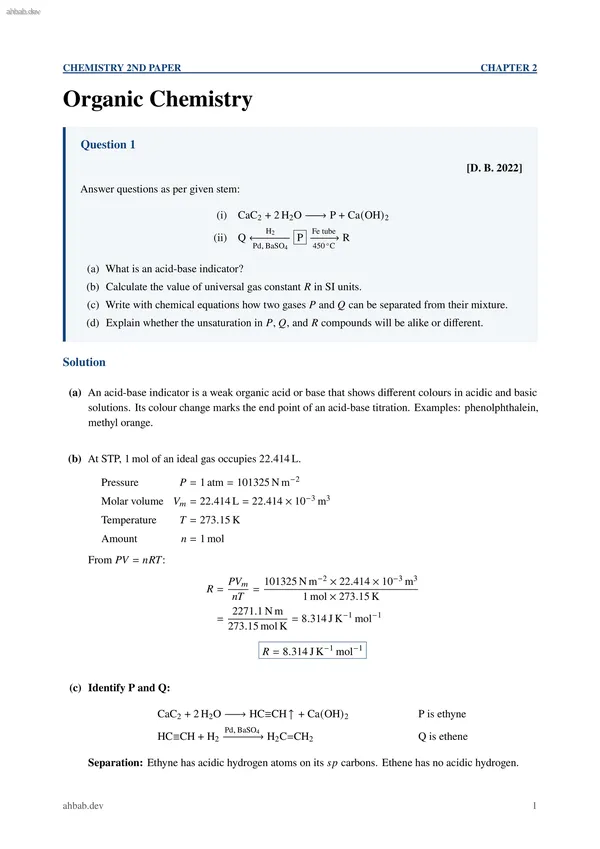
CHEMISTRY 2ND PAPER CHAPTER 2 Organic Chemistry Question 1 [D. B. 2022] Answer questions as per given stem: (i) CaC2 + 2 H2O −−−→P + Ca(OH)2 (ii) Q H2 ←−−−−−−− Pd, BaSO4 P Fe tube −−−−−→ 450 ◦C R (a) What is an acid-base indicator? (b) Calculate the value of universal gas constant 𝑅in SI units. (c) Write with chemical equations how two gases 𝑃and 𝑄can be separated from their mixture. (d) Explain whether the unsaturation in 𝑃, 𝑄, and 𝑅compounds will be alike or different. Solution (a) An acid-base indicator is a weak organic acid or base that shows different colours in acidic and basic solutions. Its colour change marks the end point of an acid-base titration. Examples: phenolphthalein, methyl orange. (b) At STP, 1 mol of an ideal gas occupies 22.414 L. Pressure 𝑃= 1 atm = 101325 N m−2 Molar volume 𝑉𝑚= 22.414 L = 22.414 × 10⁻³ m3 Temperature 𝑇= 273.15 K Amount 𝑛= 1 mol From 𝑃𝑉= 𝑛𝑅𝑇: 𝑅= 𝑃𝑉𝑚 𝑛𝑇 = 101325 N m−2 × 22.414 × 10−3 m3 1 mol × 273.15 K = 2271.1 N m 273.15 mol K = 8.314 J K−1 mol−1 𝑅= 8.314 J K−1 mol−1 (c) Identify P and Q: CaC2 + 2 H2O −−−→HC−−−CH↑+ Ca(OH)2 P is ethyne HC−−−CH + H2 Pd, BaSO4 −−−−−−−→H2C−−CH2 Q is ethene Separation: Ethyne has acidic hydrogen atoms on its 𝑠𝑝ca
1. Pass the mixture through ammoniacal cuprous chloride solution. Ethyne forms a red precipitate of copper(I) acetylide. Ethene does not react and passes out. Collect it as pure ethene (𝑄). HC−−−CH + 2 [Cu(NH3)2]Cl −−−→CuC−−−CCu↓+ 2 NH4Cl + 2 NH3 (red ppt.) 2. Filter the red precipitate and warm it with dilute HCl. Pure ethyne (𝑃) is released: CuC−−−CCu + 2 HCl −−−→HC−−−CH↑+ 2 CuCl In this way 𝑃and 𝑄are separated from their mixture. (d) Identify R: Ethyne (𝑃) passed through a red-hot iron tube trimerises to benzene: 3 HC−−−CH Fe tube −−−−−→ 450 ◦C C6H6 (R, benzene) Comparison of unsaturation: 1. P (ethyne): has a C–––C bond (1𝜎+ 2𝜋). The 𝜋electrons are localised. It adds two molecules of bromine and decolourises bromine water readily: HC−−−CH + 2 Br2 −−−→CHBr2−CHBr2 2. Q (ethene): has a C––C bond (1𝜎+ 1𝜋). The 𝜋electrons are localised. It adds one molecule of bromine readily: H2C−−CH2 + Br2 −−−→CH2Br−CH2Br 3. R (benzene): has three C––C bonds in the ring, but its 6 𝜋electrons are delocalised over all six carbons (4𝑛+ 2 = 6, aromatic). Resonance makes it very stable (about 150 kJ mol−1). So benzene does not decolourise bromine water. It gives substitution, not addition: C6H6 + Br2 F
Question 2 [D. B. 2025, 2017] Follow the given stem and answer the related questions: A (unsaturated hydrocarbon) Fe −−−−−→ 400 ◦C B CH3Cl −−−−−−−→ dry AlCl3 C [Here ‘A’ is an unsaturated hydrocarbon containing 2 carbons] (a) What is an 𝛼-glycosidic bond? (b) Why is a 2◦carbonium ion more stable than a 1◦carbonium ion? Explain. (c) How can you prepare carboxylic acid from compound ‘A’? (d) Between ‘B’ and ‘C’ of the stem, which one is more reactive in electrophilic substitution? Explain. Solution (a) An 𝛼-glycosidic bond is the C–O–C linkage formed between the –OH group on the anomeric carbon (C-1) of an 𝛼-sugar and an –OH group of another sugar, with loss of water. Example: the 𝛼(1 →4) bond in maltose and starch. (b) The stability of a carbocation increases when its positive charge is spread out. 1. Inductive effect (+𝐼): A 2◦carbocation, (CH3)2CH+, has two electron-releasing alkyl groups. A 1◦carbocation, CH3CH2+, has only one. Two alkyl groups reduce the positive charge more. 2. Hyperconjugation: (CH3)2CH+ has 6 𝛼-hydrogens and so 6 hyperconjugative structures. CH3CH2+ has only 3. More such structures spread the charge more. So a 2◦carbocation is more stable than a 1◦carbocation
21 further pages require an access key.
The pages above are free to read. The rest of this document is available to people holding a key issued by the author.