HSC Resources · Chemistry 2
Ch03 Quantitative Chemistry
Lecture slides and notes for Ch03 Quantitative Chemistry from the Chemistry 2 module in HSC Resources by Md Ahbab. 24 pages.
Content Preview
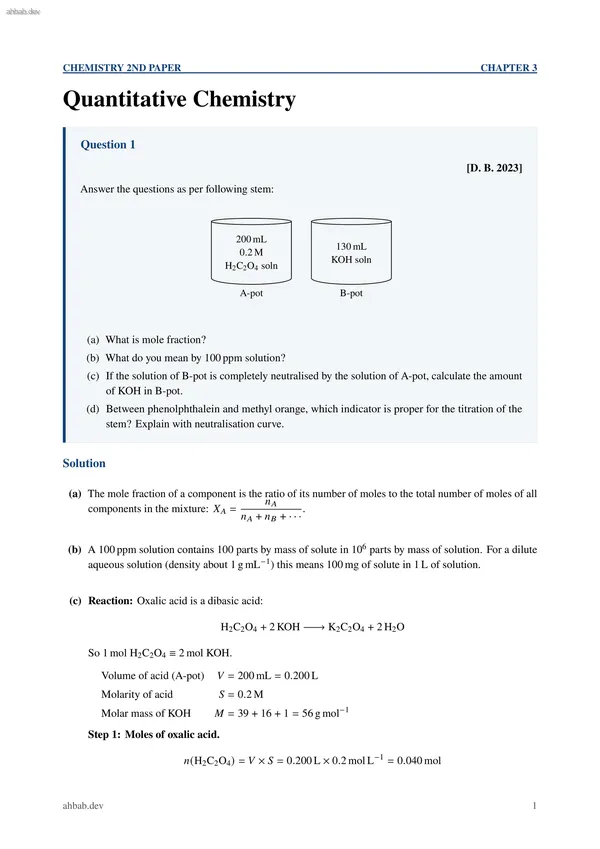
CHEMISTRY 2ND PAPER CHAPTER 3 Quantitative Chemistry Question 1 [D. B. 2023] Answer the questions as per following stem: 200 mL 0.2 M H2C2O4 soln A-pot 130 mL KOH soln B-pot (a) What is mole fraction? (b) What do you mean by 100 ppm solution? (c) If the solution of B-pot is completely neutralised by the solution of A-pot, calculate the amount of KOH in B-pot. (d) Between phenolphthalein and methyl orange, which indicator is proper for the titration of the stem? Explain with neutralisation curve. Solution (a) The mole fraction of a component is the ratio of its number of moles to the total number of moles of all components in the mixture: 𝑋𝐴= 𝑛𝐴 𝑛𝐴+ 𝑛𝐵+ · · ·. (b) A 100 ppm solution contains 100 parts by mass of solute in 106 parts by mass of solution. For a dilute aqueous solution (density about 1 g mL−1) this means 100 mg of solute in 1 L of solution. (c) Reaction: Oxalic acid is a dibasic acid: H2C2O4 + 2 KOH −−−→K2C2O4 + 2 H2O So 1 mol H2C2O4 ≡2 mol KOH. Volume of acid (A-pot) 𝑉= 200 mL = 0.200 L Molarity of acid 𝑆= 0.2 M Molar mass of KOH 𝑀= 39 + 16 + 1 = 56 g mol−1 Step 1: Moles of oxalic acid. 𝑛(H2C2O4) = 𝑉× 𝑆= 0.200 L × 0.2 mol L−1 = 0.040 mol ahbab.dev 1
Step 2: Moles of KOH neutralised. 𝑛(KOH) = 2 × 0.040 = 0.080 mol Step 3: Mass of KOH in B-pot. 𝑤= 𝑛× 𝑀= 0.080 mol × 56 g mol−1 = 4.48 g Amount of KOH in B-pot = 0.080 mol = 4.48 g (d) The titration is between a weak acid (H2C2O4) and a strong base (KOH). pH at the equivalence point: The salt K2C2O4 forms. The oxalate ion is hydrolysed and produces OH– ions: C2O42−+ H2O −−−⇀ ↽−−−HC2O4−+ OH− So the solution at the equivalence point is slightly basic (pH about 8.5 to 9). Neutralisation curve (pH against volume of KOH added to A-pot): 0 50 100 130 150 200 0 2 4 6 8 10 12 14 phenolphthalein (8.3–10.0) methyl orange (3.1–4.4) equivalence point Volume of KOH added (mL) pH • The steep (vertical) part of the curve near the equivalence point lies at about pH 6.5 to 11, in the basic region. • Phenolphthalein changes colour at pH 8.3 to 10.0. This range lies on the steep part, so one drop of KOH at the end point turns the solution pink. • Methyl orange changes colour at pH 3.1 to 4.4. This range lies on the flat part of the curve, well before the equivalence point. It would change colour too early. Conclusion: Phenolphthalein is the proper indicator for this titration. ahbab.dev 2
Question 2 [Ch. B. 2025] Answer the following stem related questions: 0.1 M H2SO4 100 mL Beaker-A NH4OH soln Beaker-B NaOH soln Beaker-C (a) What is tautomerism? (b) The COD value of a water sample is greater than its BOD value; explain. (c) If 4.9 g H2SO4 is added to the solution in Beaker-A, calculate the ppm concentration of the final solution. (d) As per the stem, can the same indicator be used in the titration of ‘A’ with ‘B’ and ‘A’ with ‘C’? Explain theoretically. Solution (a) Tautomerism is a type of isomerism in which two isomers change into each other by the shift of a hydrogen atom and a double bond, and stay in dynamic equilibrium. Example: keto-enol tautomerism, CH3COCH3 −−−⇀ ↽−−−CH3C(OH)––CH2. (b) BOD is the oxygen used by bacteria to oxidise only the biodegradable organic matter in water (in 5 days at 20 ◦C). COD is the oxygen needed to oxidise both biodegradable and non-biodegradable matter chemically by a strong oxidant (acidified K2Cr2O7). Substances such as plastics, lignin and some detergents are oxidised in the COD test but not in the BOD test. So COD is greater than BOD. (c) Assume the volume stays 100 mL after adding the acid. Volume of solution 𝑉= 100 mL = 0
21 further pages require an access key.
The pages above are free to read. The rest of this document is available to people holding a key issued by the author.