HSC Resources · Chemistry 2
Ch04 Electrochemistry
Lecture slides and notes for Ch04 Electrochemistry from the Chemistry 2 module in HSC Resources by Md Ahbab. 23 pages.
Content Preview
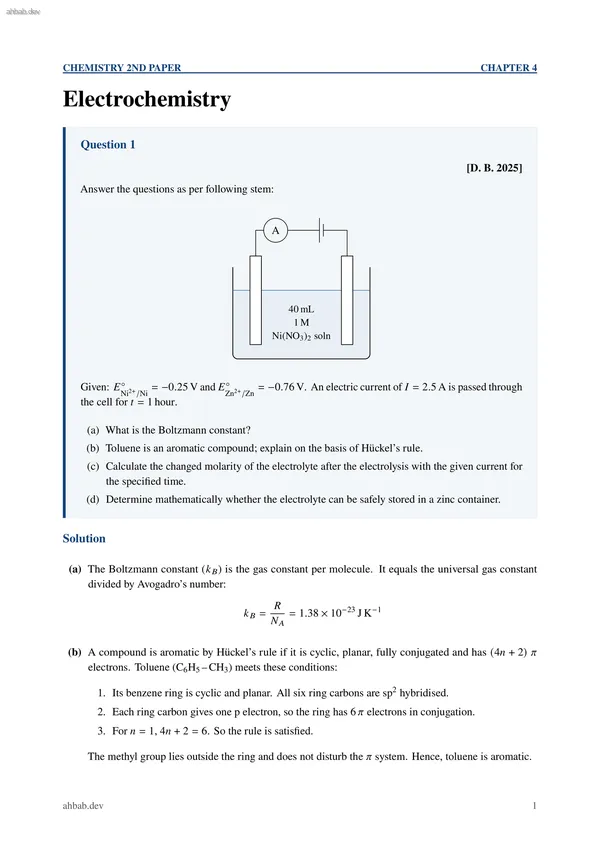
CHEMISTRY 2ND PAPER CHAPTER 4 Electrochemistry Question 1 [D. B. 2025] Answer the questions as per following stem: 40 mL 1 M Ni(NO3)2 soln A Given: 𝐸◦ Ni2+/Ni = −0.25 V and 𝐸◦ Zn2+/Zn = −0.76 V. An electric current of 𝐼= 2.5 A is passed through the cell for 𝑡= 1 hour. (a) What is the Boltzmann constant? (b) Toluene is an aromatic compound; explain on the basis of Hückel’s rule. (c) Calculate the changed molarity of the electrolyte after the electrolysis with the given current for the specified time. (d) Determine mathematically whether the electrolyte can be safely stored in a zinc container. Solution (a) The Boltzmann constant (𝑘𝐵) is the gas constant per molecule. It equals the universal gas constant divided by Avogadro’s number: 𝑘𝐵= 𝑅 𝑁𝐴 = 1.38 × 10⁻²³ J K−1 (b) A compound is aromatic by Hückel’s rule if it is cyclic, planar, fully conjugated and has (4𝑛+ 2) 𝜋 electrons. Toluene (C6H5 –CH3) meets these conditions: 1. Its benzene ring is cyclic and planar. All six ring carbons are sp2 hybridised. 2. Each ring carbon gives one p electron, so the ring has 6 𝜋electrons in conjugation. 3. For 𝑛= 1, 4𝑛+ 2 = 6. So the rule is satisfied. The methyl group lies outside the ring and does n
(c) Changed molarity of the electrolyte: Volume of solution 𝑉= 40 mL = 0.040 L Initial molarity 𝑀1 = 1 M Current 𝐼= 2.5 A Time 𝑡= 1 hour = 3600 s Faraday’s constant 𝐹= 96500 C mol−1 The rods are taken as inert, and the volume is taken as constant. Cathode reaction: Ni2+(aq) + 2 e−−−−→Ni(s) Step 1: Charge passed. 𝑄= 𝐼× 𝑡= 2.5 A × 3600 s = 9000 C Step 2: Moles of Ni2+ that this charge can reduce. 𝑛= 𝑄 2𝐹= 9000 C 2 × 96500 C mol−1 = 0.0466 mol Step 3: Moles of Ni2+ present at the start. 𝑛1 = 𝑀1 × 𝑉= 1 mol L−1 × 0.040 L = 0.040 mol Step 4: Comparison. Since 0.0466 mol > 0.040 mol, the charge is more than enough. All the Ni2+ is deposited. 𝑡used = 2𝑛1𝐹 𝐼 = 2 × 0.040 × 96500 2.5 = 3088 s = 51.5 min So no Ni2+ is left after 51.5 min. In the remaining time, the current only decomposes water. Final molarity of Ni(NO3)2 = 0 M (changed from 1 M) (d) Can the electrolyte be stored in a zinc container? If zinc reacts with the solution, the half reactions are: Oxidation half: Zn(s) −−−→Zn2+(aq) + 2 e− Reduction half: Ni2+(aq) + 2 e−−−−→Ni(s) Overall reaction: Zn(s) + Ni2+(aq) −−−→Zn2+(aq) + Ni(s) The emf of this reaction is: 𝐸◦ cell = 𝐸◦ Ni2+/Ni −𝐸◦ Zn2+/Zn = −0.25 V −(−0.76 V) = +0.51 V The emf
Question 2 [J. B. 2023] Answer the questions as per following stem: AgNO3 soln + − Graphite rod Silver rod 𝑡= 20 min 𝐼= 8 A An electrolytic cell consists of a graphite rod and a silver rod immersed in an aqueous AgNO3 solution, as shown in the figure. A steady current of 8 A is passed through the cell for 20 min. (a) What is partial pressure? (b) Calculate the oxidation number of the central atom in K4[Fe(CN)6]. (c) State and explain the quantitative law related to the electrolysis in the given cell. (d) How many atoms of silver will be deposited on the cathode? Explain mathematically. [Atomic mass of Ag = 108 g mol−1] Solution (a) Partial pressure is the pressure that one gas in a gas mixture would exert if it alone filled the whole container at the same temperature. (b) The central atom in K4[Fe(CN)6] is iron. The oxidation number of K is +1 and the charge on CN– is −1. Let the oxidation number of Fe be 𝑥: 4(+1) + 𝑥+ 6(−1) = 0 =⇒4 + 𝑥−6 = 0 =⇒𝑥= +2 So the oxidation number of the central atom Fe is +2. (c) Faraday’s first law of electrolysis: The mass (𝑊) of a substance deposited or dissolved at an electrode is directly proportional to the charge (𝑄) passed through the electrolyte
20 further pages require an access key.
The pages above are free to read. The rest of this document is available to people holding a key issued by the author.