CS Graduate Preparation
Book1
Lecture slides and notes for Book1 in CS Graduate Preparation by Md Ahbab. 85 pages.
Content Preview
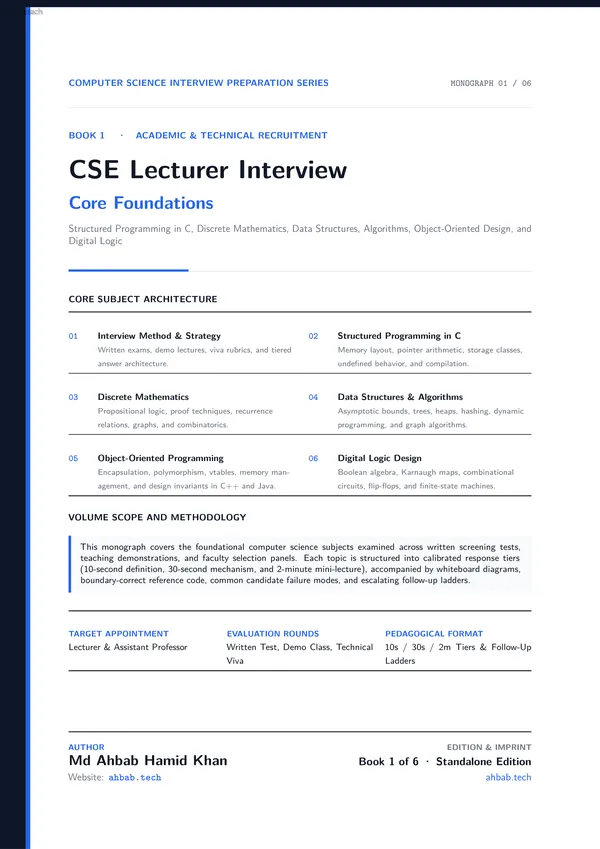
COMPUTER SCIENCE INTERVIEW PREPARATION SERIES MONOGRAPH 01 / 06 BOOK 1 · ACADEMIC & TECHNICAL RECRUITMENT CSE Lecturer Interview Core Foundations Structured Programming in C, Discrete Mathematics, Data Structures, Algorithms, Object-Oriented Design, and Digital Logic CORE SUBJECT ARCHITECTURE 01 Interview Method & Strategy Written exams, demo lectures, viva rubrics, and tiered answer architecture. 02 Structured Programming in C Memory layout, pointer arithmetic, storage classes, undefined behavior, and compilation. 03 Discrete Mathematics Propositional logic, proof techniques, recurrence relations, graphs, and combinatorics. 04 Data Structures & Algorithms Asymptotic bounds, trees, heaps, hashing, dynamic programming, and graph algorithms. 05 Object-Oriented Programming Encapsulation, polymorphism, vtables, memory man- agement, and design invariants in C++ and Java. 06 Digital Logic Design Boolean algebra, Karnaugh maps, combinational circuits, flip-flops, and finite-state machines. VOLUME SCOPE AND METHODOLOGY This monograph covers the foundational computer science subjects examined across written screening tests, teaching demonstrations, and faculty selection panels. Each topic i
Contents How to Use This Book iv I Interview Method and Answering Strategy 1 1 The Recruitment Landscape (P1) 2 1.1 The three rounds . . . . . . . . . . . . . . . . . . . . . . . . . . . . . . . . . . . . . 2 1.2 Subject priority map . . . . . . . . . . . . . . . . . . . . . . . . . . . . . . . . . . . 2 1.3 Panel Evaluation Criteria . . . . . . . . . . . . . . . . . . . . . . . . . . . . . . . . 2 2 The Answering Engine (P1) 4 2.1 The 10 / 30 / 120 ladder . . . . . . . . . . . . . . . . . . . . . . . . . . . . . . . . . 4 2.2 The ten-verb competence ladder . . . . . . . . . . . . . . . . . . . . . . . . . . . . 4 2.3 Board discipline . . . . . . . . . . . . . . . . . . . . . . . . . . . . . . . . . . . . . . 5 2.4 Defending, and the honest-unknown protocol . . . . . . . . . . . . . . . . . . . . . 5 2.5 The 10-minute demo class template . . . . . . . . . . . . . . . . . . . . . . . . . . . 5 2.6 Rapid revision: Part I . . . . . . . . . . . . . . . . . . . . . . . . . . . . . . . . . . 6 II C Programming and Structured Programming 7 3 Structured Programming in C (P1) 8 3.1 Definition of Structured Programming . . . . . . . . . . . . . . . . . . . . . . . . . 8 3.2 The compilation p
Contents Book 1: Core Foundations 4.3 Methods of proof . . . . . . . . . . . . . . . . . . . . . . . . . . . . . . . . . . . . . 19 4.4 Sets, relations and functions . . . . . . . . . . . . . . . . . . . . . . . . . . . . . . . 20 4.5 Counting, permutations and the pigeonhole principle . . . . . . . . . . . . . . . . . 20 4.6 Recurrence relations and the Master Theorem . . . . . . . . . . . . . . . . . . . . . 21 4.7 Graph theory essentials . . . . . . . . . . . . . . . . . . . . . . . . . . . . . . . . . 21 4.8 Number theory for computing . . . . . . . . . . . . . . . . . . . . . . . . . . . . . . 22 4.9 Rapid revision: Discrete Mathematics . . . . . . . . . . . . . . . . . . . . . . . . . 23 IV Data Structures and Algorithms 25 5 Linear Data Structures (P1) 26 5.1 Abstract data types, arrays and complexity notation . . . . . . . . . . . . . . . . . 26 5.2 Linked lists (P1) . . . . . . . . . . . . . . . . . . . . . . . . . . . . . . . . . . . . . 27 5.3 Stacks and their applications (P1) . . . . . . . . . . . . . . . . . . . . . . . . . . . 29 5.4 Queues, circular queues, deques and priority queues (P1) . . . . . . . . . . . . . . . 31 5.5 Rapid revision: linear structures . . . .